License Management
Manage your Develocity license, including monitoring status, handling expiration events, and performing updates in both online and air-gapped environments.
License Status & Expiration
You can view your current license entitlements, feature sets, and expiration date by navigating to .
Impact of Expiration
If your license expires, Develocity enters a Read-Only mode. In this state, the following permissions aren’t granted to any users:
-
Publish Build Scan
-
Read and write Build Cache data
-
Use Test Distribution
Existing Build Scan data remains viewable.
| The Read Build Cache data permission will continue to function as normal for users who have it. However, it won’t be automatically granted to users who had "Read and write Build Cache data". |
Full functionality will be restored if the Develocity license expiration date is updated (see below), and users' permissions will be restored automatically.
|
In some environments, Kubernetes may fail to pull Develocity Docker images or fail to start new instances if the license check remains in a failed state for an extended period. |
Updating Your License
The method for updating your license depends on whether your Develocity instance has internet access.
Online Installations (Automatic)
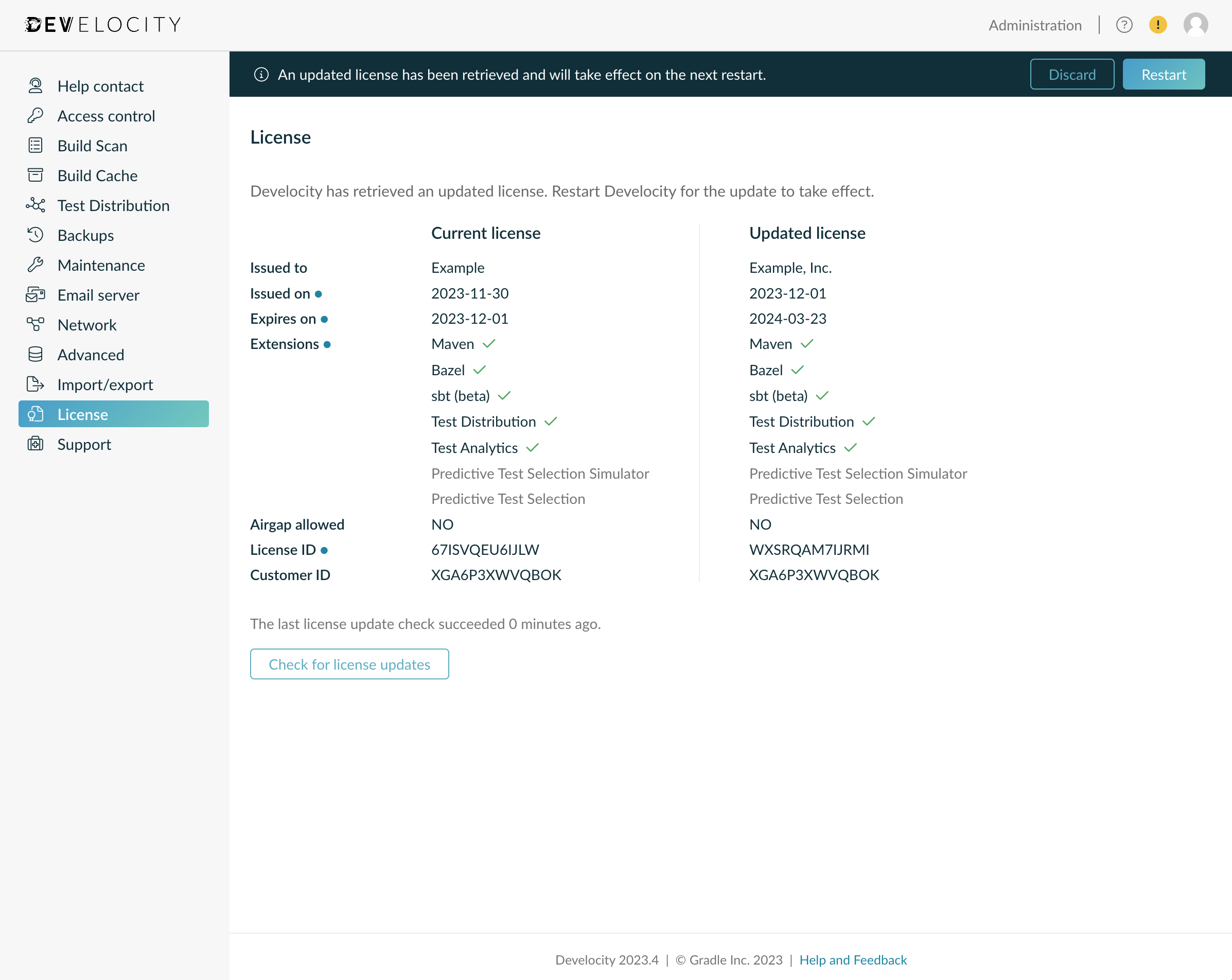
Online instances automatically check the Gradle license server for updates on startup and every hour thereafter. If a license update requires a restart to take effect, a notification is displayed to administrators.
For online installations, all that’s needed to avoid expiration is to ensure that your customer success representative has extended your license. There is no need to obtain or install a new license file, as the update will be applied automatically. If the application has failed to start due to license expiration, restart it after your customer success representative has extended your license.
The tab can also be used to:
-
Verify the current license’s information, such as expiration date
-
Compare the current license and updated license (when an updated license has been downloaded)
-
Restart Develocity to apply the updated license (when an updated license has been downloaded)
-
Check whether license checks are functioning properly
-
Initiate an on-demand license check
|
If license checks fail consistently for 72 hours, the instance will fail to restart until connectivity is restored or a valid license is applied. |
Airgap Installations (Manual)
Airgap instances don’t receive automatic license updates. Follow this sequence to manually update your license.
1. Obtain the License Key
Contact your Customer Success representative to receive your updated license file or key.
2. Update the Configuration
The license is provided through the global.license Helm value, not the unattended configuration file.
Update your values.yaml with the new license file contents:
global:
  license:
    file: «develocity.license contents» (1)
| 1 | The contents of the new develocity.license file. Alternatively, keep the license out of values.yaml and pass the file at upgrade time with --set-file global.license.file=./develocity.license, or reference a Kubernetes secret with global.license.secretName. |
3. Apply the Changes
Run helm upgrade against your installation to roll out the new license.
This applies to both Kubernetes and Standalone installations; the full upgrade commands are shown in the "Changing Configuration Values" sections of the Kubernetes and Standalone Helm chart configuration guides.
Configure via Helm
If you are managing Develocity using a GitOps or automated workflow, note that the license isn’t part of the Unattended Configuration schema.
Manage it as a Helm value instead, either inline in values.yaml (global.license.file), as a --set-file global.license.file argument, or as a Kubernetes secret referenced with global.license.secretName.
Deployment Templates
Download the appropriate YAML template to begin your infrastructure configuration.
For Develocity versions 2025.3 and prior, see the 2025.2 Administration Guide or the 2025.3 Administration Manual.
| Cluster Deployment |
Example template for cluster orchestration. |
| Standalone Deployment |
Example template for standalone setup. |
|
Pre-deployment Checklist
See Unattended Configuration for details. |
Further details can be found in the "Changing configuration values" sections of the Standalone and Kubernetes Helm chart configuration guides.
Troubleshooting
-
Expiration Mismatch: If the date in the UI doesn’t match your contract, contact support.gradle.com.
-
Connectivity: If online updates fail, verify your Proxy Settings.
-
Support Bundles: If license issues persist, generate a Support Bundle for investigation.